

Learn before you build.
Use AI simulations to test ideas, designs and ads, focus your research budget and make better-informed product decisions.
Teams can build faster than they can learn from customers. Sunzu simulates human behaviour with AI so you can explore a decision before committing development time or campaign budget.
When research cannot keep pace with delivery, teams make expensive commitments with unanswered questions. A feature enters development, a design reaches engineering or an ad goes live before the team has explored how customers might respond.
The opportunity is to learn earlier: compare options while they are inexpensive to change, surface likely objections and focus human research on the questions that matter most.
Asking a general-purpose AI to act as a customer can help generate hypotheses. A convincing answer alone does not establish what your customers think. To inform a decision, the team needs to understand the evidence behind the simulation and how its findings compare with human research.
Sunzu’s composable AI combines 20+ layers, including algorithms and small models. It brings audience modelling and research workflows together so you can explore likely responses to a question, concept, design or ad, then review those responses against the evidence available.
Define who you are testing with
An audience model describes a customer group. Individual personas simulate responses within that group.
Existing interviews, surveys, support themes and other customer evidence give the simulation context. Relevant supporting data can broaden that context. Source links let reviewers inspect the basis for the audience model.
The model describes the people, their motivations and the situation being tested. It also records gaps in the evidence. A simulated response is an inference about a customer, not a statement collected from that customer.
Read how Sunzu simulates human behaviour for the method, model checks and benchmark interpretation.
From discovery to launch
Use simulations where an answer can change what you build, how you design it or what you say.
The web app supports depth interviews, concept testing, UX testing and ad testing. Depth interviews, concept tests and UX tests are also available through a compatible AI assistant such as Claude using the MCP connector.
A shared audience lets researchers, product managers, designers and marketers work from the same customer context. Each team can explore its own question and review the evidence behind the answer.
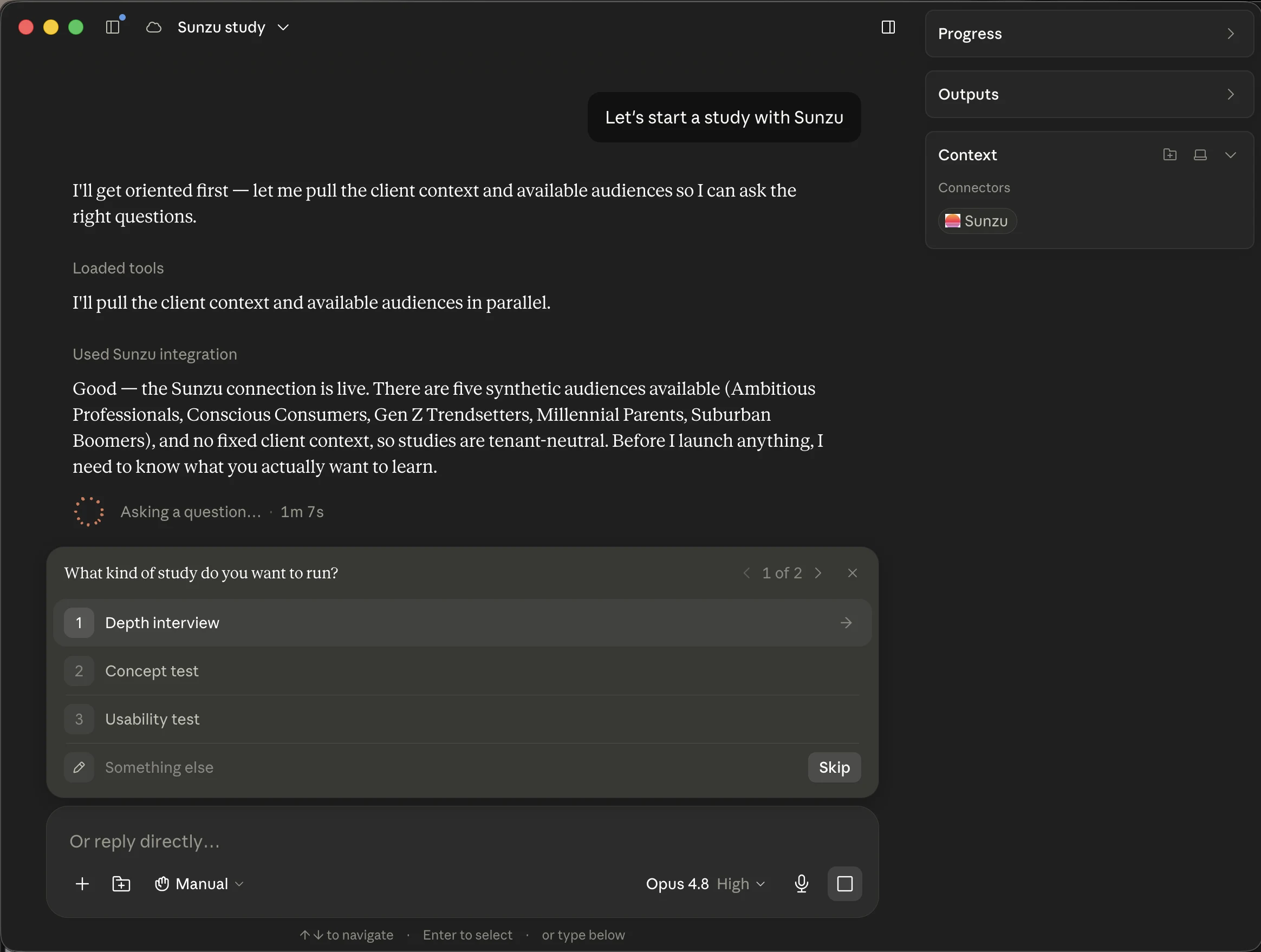
Four stages, four study types
- Discover · Depth interviews
- Frame · Concept testing
- Shape · UX testing
- Launch · Ad testing
Discover and frame. Explore needs, objections and trade-offs through simulated depth interviews. Compare concepts to identify questions worth resolving before choosing a direction.
Shape and launch. Use UX testing to investigate likely friction in a design. Use ad testing to explore how a message may be understood and which objections deserve attention before campaign spend.
Explore the four research stages on the homepage.
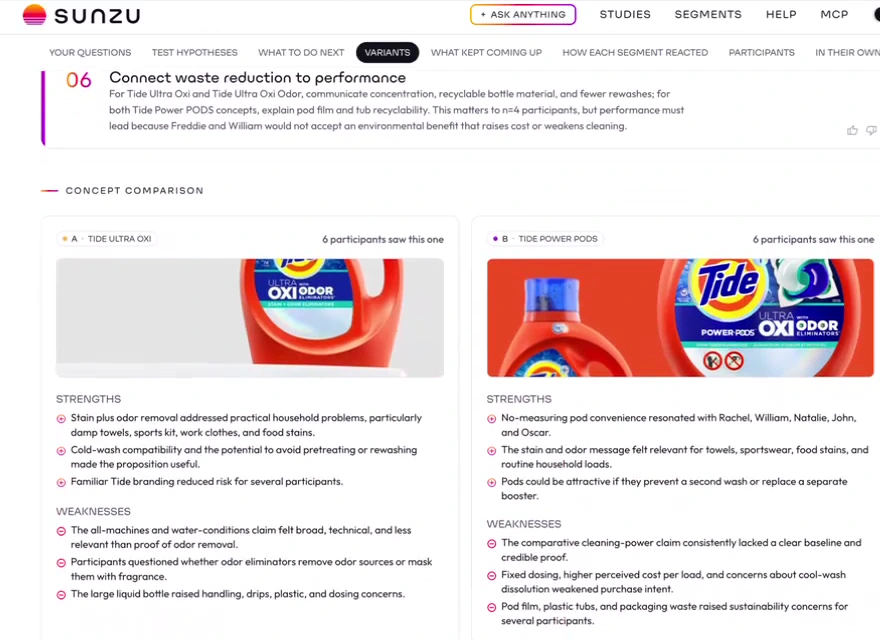
Illustrative decision: monthly or annual billing. Test both propositions with the same audience and examine the objections, trade-offs and unanswered questions. Use those findings to refine the offer and design a focused customer study before changing pricing.
This illustrates a workflow, not a customer result. Whether a change improves conversion or retention must be measured with real customers.
Can I trust the data?
Start with the sources, the fit between the audience and your question, and the relevant benchmark. Sunzu uses internal back-testing against human research to assess and refine audience models. Adjusting a model to known findings is calibration; confidence on a new decision requires evaluation on findings that were not used for that adjustment.
See the study benchmarks and how to interpret them.
Audience or real customers?
Use simulations to compare early options and focus the next study. Work directly with people when a decision depends on lived experience, accessibility, cultural context or behaviour the available evidence does not capture. Validate consequential decisions with evidence appropriate to their risk.
How do I get started?
Choose the enterprise or startup route, or book a call to discuss your first study.
Measure what changes
A useful pilot connects a research finding to a decision, and a decision to an outcome.
Choose a decision. Start with a question your team is already trying to answer. Define what would change your choice and identify the human evidence you will use to judge the simulation.
Check the findings. Compare what the simulation recovered, missed or added without support. Keep the evaluation evidence separate from the material used to build or tune the audience. Review disagreements before acting on them.
Count the full cost. Track preparation, audience setup, running the study, reviewing results and follow-up research. Compare total elapsed time, staff effort and direct spending with your existing process.
Follow the decision. Record whether the findings changed a concept, design or campaign. Measure any later business outcome separately. More tests and faster answers are useful only when they improve decisions or reduce the effort needed to reach them.
The aim is to make customer insight available while a decision can still change. Start with your evidence, test a specific question and measure whether Sunzu helps your team reach a better-informed decision with less time and effort.
Get user insights in minutes.
Shape products people love.
Next in the series → How Sunzu simulates human behaviour (Nº 02).